
Why Kaštela is an unusually good starting point
Kaštel Stari lies exactly halfway between Split and Trogir, a few minutes from the A1 motorway slip road and about ten minutes' drive from the airport. That sounds unspectacular, but it is the practical advantage of this location: in the morning you don't have to fight your way through the traffic of a big city before the trip begins. If you stay in Split, you quickly lose forty minutes in August just getting out and looking for parking in the evening.
We have sorted the following destinations by realistic drive time from Kaštela – by hire car, outside rush hour, without stops. And we say what is genuinely worth doing as a day trip and what you should better skip or combine with an overnight stay.
Up to 30 minutes: the obvious first
Trogir
About ten minutes west. The old town on its little island is a UNESCO World Heritage Site, and it is small enough that a morning is enough: the Cathedral of St Lawrence with the Radovan Portal, Kamerlengo Fortress, the waterfront promenade. Go early or towards evening – at midday between two cruise groups it gets cramped.
Salona (Solin)
About 15 to 20 minutes towards Split. Salona was the capital of the Roman province of Dalmatia and, with an estimated several tens of thousands of inhabitants, one of the largest cities on the Adriatic. What stands today – amphitheatre, basilicas, city walls – lies spread out among cypresses and fields. The site has little shade: hat, water, sturdy shoes. It's best to check opening times and admission on the day with the Archaeological Museum Split or the Solin tourist board.
Klis Fortress
About 25 minutes. The fortress sits on a rocky ridge in the only natural pass between the coast and the hinterland – which is why fighting went on here for centuries, against Ottomans and Venetians alike. From the top you see the entire Kaštela bay as far as Split. Series fans will recognise the backdrop from Game of Thrones. Klis combines well with Salona; both lie almost in a line.
Split
20 to 30 minutes, in summer more. Diocletian's Palace is not a museum but an inhabited district of the city: cafés in ancient substructures, washing lines over Roman masonry. Our tip is to treat Split as an afternoon and evening destination, not a day trip – from about 5 pm the cruise guests are gone and the parking spaces are free.
30 to 60 minutes: waterfalls, river mouths, island ports
Krka National Park
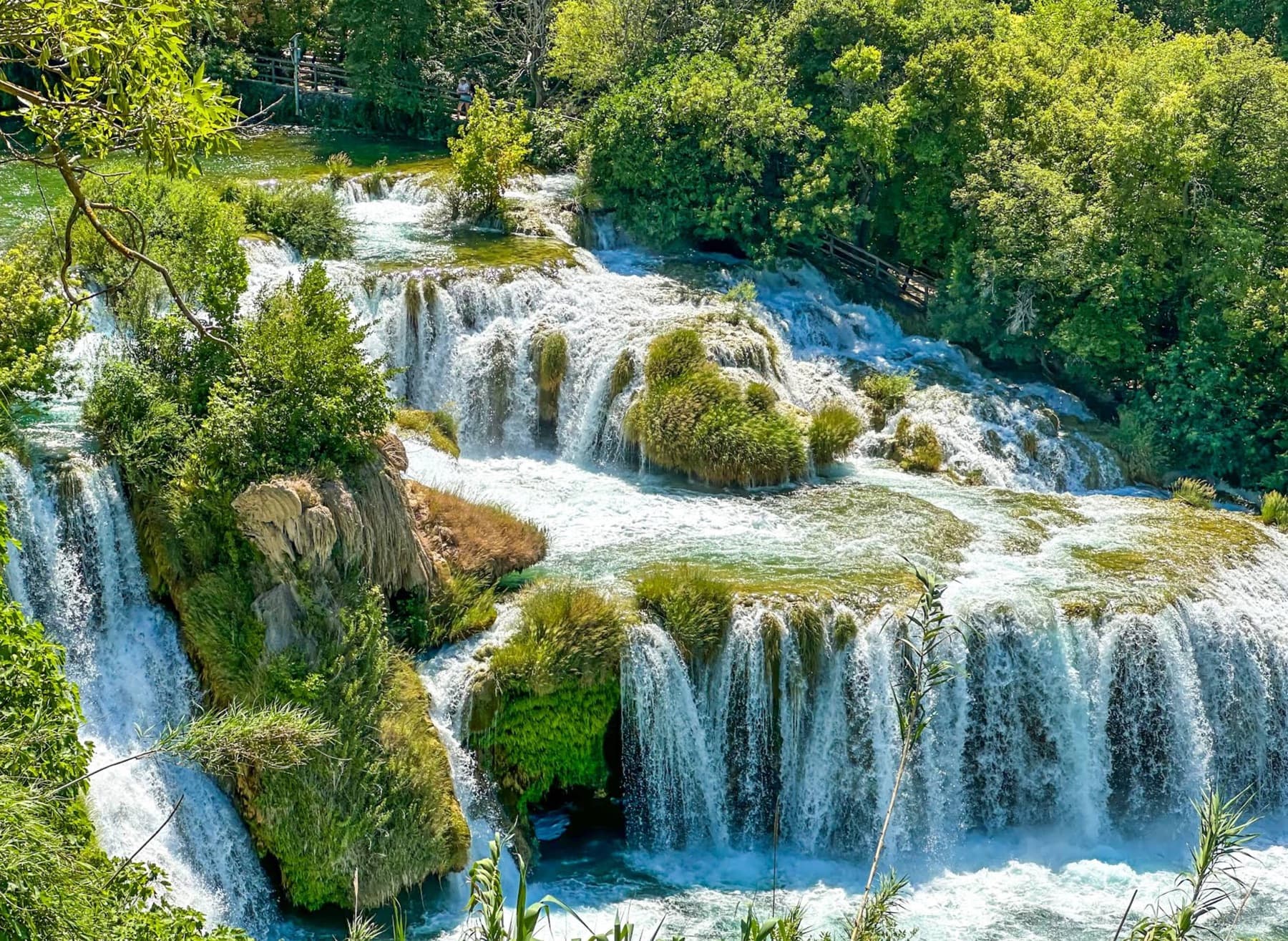
About an hour via the A1 to the Lozovac entrance. Skradinski Buk is the well-known cascade staircase; from the Lozovac car park a free shuttle bus takes you down in season, or you can drive to Skradin and take the park boat. Important and often outdated in guidebooks: swimming at Skradinski Buk has been banned since January 2021. If you want to swim, plan to include the northern part of the park – swimming is only allowed at the designated spots Roški slap, Stinice and Pisak, from 1 June to 30 September. Outside the park you can get in the water in the channel near Skradin. Admission prices are tiered by season and are considerably higher in high season than in spring – the binding rates and opening times are on npkrka.hr, so book your time slot online in advance.
Šibenik
Just under an hour. The Cathedral of St James is built entirely of stone, without mortar and without wood, and is on the UNESCO list. Above it sits St Michael's Fortress with an open-air stage. Šibenik is much quieter than Split and combines well with Krka on a long day if you only want to look at both and not hike through them.
Omiš and the Cetina Gorge
45 to 55 minutes along the coast road south of Split. The town is wedged between a steep cliff and the river mouth; it's twenty sweaty minutes up to the pirate fortress Mirabela. Upstream it gets more exciting: rafting on the Cetina, a zipline across the gorge, or simply lunch in one of the mill konobas on the water. For families with older children, this is the most varied day within a 60-minute radius.
Šolta and the Blue Lagoon
Two ways to the turquoise water. The Jadrolinija car ferry crosses from Split to Rogač on Šolta, a crossing of about an hour, several times a day in peak season. You reach the Blue Lagoon near the Krknjaši islets east of Drvenik Veli most easily on a boat tour from Trogir or Seget – the car ferry to Drvenik Veli also runs, but is needlessly complicated for a day trip. Always check timetables and prices directly with Jadrolinija; they change each season.
Sinj
About 45 minutes inland. The pilgrimage church with its miraculous image and the Sinjska Alka knights' tournament, held every year in early August and counted as UNESCO intangible cultural heritage, make Sinj a worthwhile contrast to the coast. Confirm dates beforehand with the tourist board.
One to two hours: islands and karst landscape
Brač with Zlatni Rat
The Split–Supetar car ferry takes about 50 minutes and runs ten to fourteen times a day in summer. From Supetar to Bol it is about 35 kilometres across the island's interior, a good 40 minutes. Allow for waiting time at the ramp in Split – in August the cars queue early, so reserve online. If you only want to see the Golden Horn, the catamaran straight to Bol is quicker, but then you can't take a car. Brač works as a day trip if you take the first morning ferry.
Imotski: Red and Blue Lake
A good hour to an hour and a quarter into the hinterland. Two collapsed karst caves, the Red Lake with walls of over 200 metres, the Blue Lake with a water level that fluctuates greatly over the year – in late summer it is sometimes almost empty. The descent to the Blue Lake is doable but steep and hot. Half a day is enough, easily combined with a meal in the region.
Zadar
About 1 hour 45 via the A1. The Sea Organ and Greeting to the Sun on the Riva are rightly famous, plus the Roman forum and the round church of St Donatus. A day trip is possible but makes for a long day – it is nicer if you take in the sunset on the Riva and only then drive back.
Over two hours: what we honestly don't recommend
Plitvice Lakes
About 240 to 250 kilometres, depending on traffic 2.5 to 3.5 hours each way. As a day trip that means about twelve hours door to door, six of them in the car – with children in high summer that is no pleasure. For 2026 the national park quotes, in the main season (1 June to 30 September), 40 euros for adults until 4 pm and 25 euros for late entry, 23 euros in spring and October, 10 euros in winter. Swimming is banned throughout the park. Our recommendation: either plan an overnight stay near the park or visit Krka instead. If Plitvice is a must, then as a stopover on the way here or home.
Hvar
The catamaran from Split reaches Hvar town in about an hour but takes no vehicles. By car you take the ferry to Stari Grad, a good two hours, plus about 20 minutes overland to Hvar town. As a day tour, Hvar is only worthwhile without a car and with the intention of staying in one place. For the island as a whole, two overnight stays is the more honest answer.
In practice: parking, tolls, fuel, start time
Parking in Split and Trogir
Split uses colour-coded parking zones; the most expensive zone around the old town is also limited to two hours, after which you really have to move the vehicle. Paying by SMS often works only with a Croatian SIM – download an app such as Bmove or PayDo beforehand. More relaxed is the large car park at Žnjan beach or one of the shopping centres with a shuttle, then take the bus into town from there. In Trogir it's best to park on the mainland before the bridge; you can't get into the old town by car anyway.
Tolls and fuel
Croatia has no vignette but distance-based tolls: you take a ticket on entry and pay on exit, in cash or by card. Short stretches cost a few euros, longer ones correspondingly more. Fill up in town rather than at the motorway services, which is noticeably cheaper, and expect queues at the toll booths heading north at weekends in July and August.
When to set off
For national parks and islands: leave before 7:30 am. The coaches from Split reach Krka around ten, and the ferries to Brač are full from late morning. For cities the opposite applies – go only in the afternoon, when the day visitors leave. Between 12 and 4 pm, a shady courtyard and a pool at home are almost always the better decision than another sight.
How we would divide a week
- Arrival day and day 2: don't drive anywhere. Trogir in the early evening.
- Day 3: Krka early, back via Šibenik.
- Day 4: boat to the Blue Lagoon or a beach day in Kaštela.
- Day 5: Klis and Salona in the morning, Split from 5 pm.
- Day 6: Brač on the first ferry, or Omiš and the Cetina.
- Day 7: Imotski or Sinj – or again, don't drive anywhere.
You'll find more background on regions, getting here and the seasons in our Croatia travel guide . You can see our private villas with a pool in Kaštel Stari under villas and availability . And if you're unsure which trips suit your travel party: write to us via the contact page ; we know the routes from our own experience and reply in German.
One last note: admission prices, ferry timetables and opening times in Croatia often change, sometimes at short notice. Check the official websites of the national parks and Jadrolinija shortly before your trip – that spares you the most unpleasant of all holiday experiences, namely two hours' journey to a closed gate.