
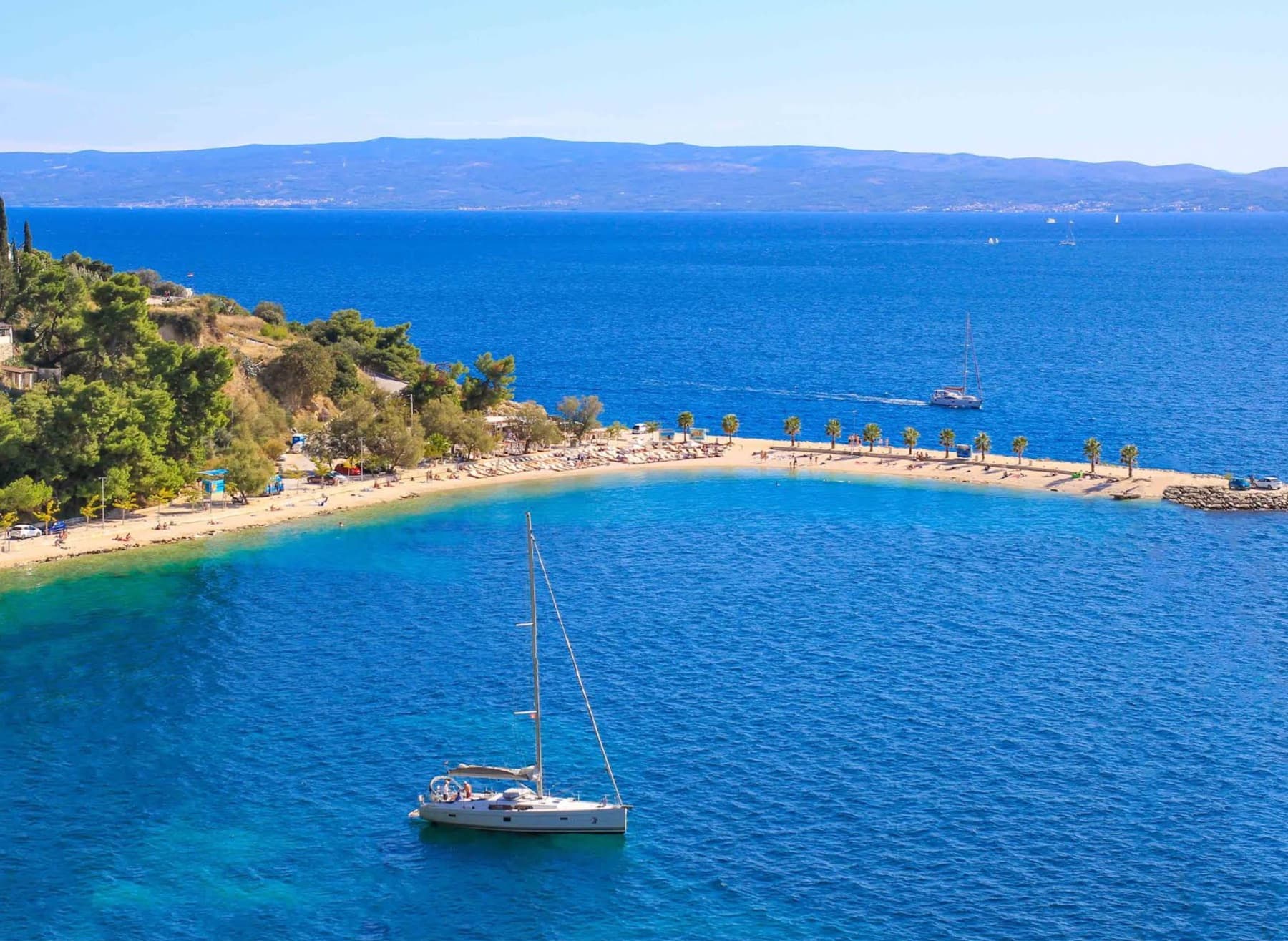
Seven towns, one mountain, one sheltered bay
Kaštela is not a single place but a chain of seven small towns stretching about 15 kilometres between Split and Trogir. Each grew up around a castle in the 15th and 16th centuries, built by noble families such as the Cipikos, Vitturis and Cambis as summer residences and as protection against Ottoman raids. Today these cores lie close to the water, with waterside paths, shingle coves, fishing harbours and konobas in between.
Behind them stands Kozjak, a long karst ridge that shields the riviera from the north. In front lies the Kaštela Bay (Kaštelanski zaljev), a sheltered bay open to the south. That explains why the sea usually stays calmer here than on the open coast.
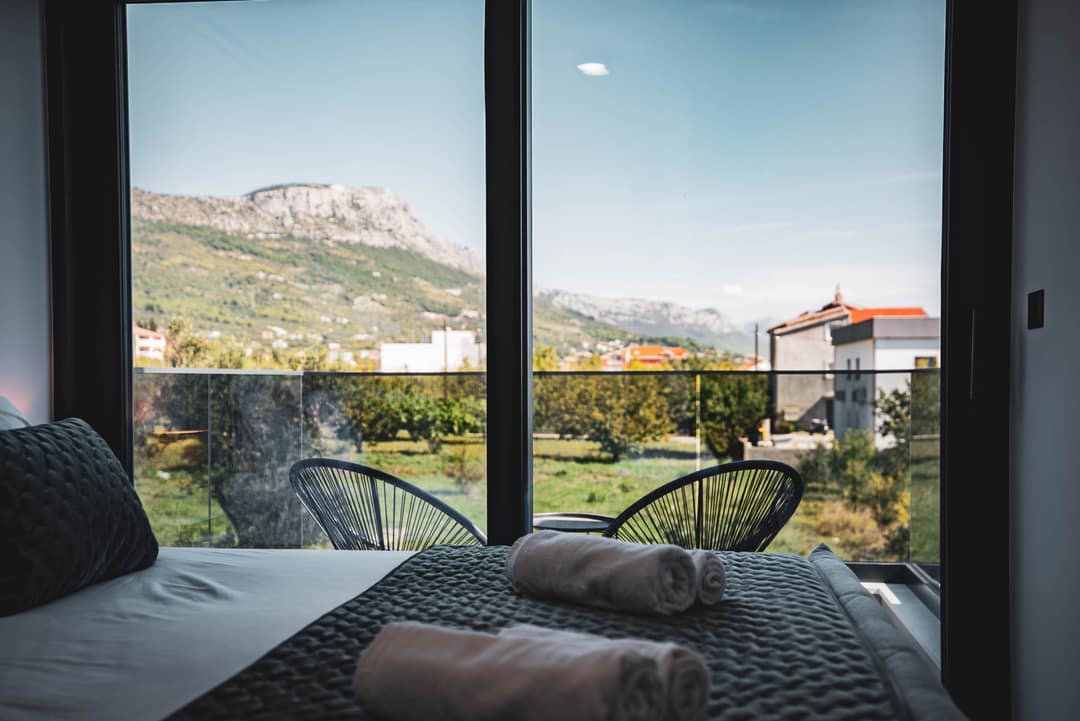
Right on your doorstep: the beaches of Kaštela
If you rent a holiday villa in Kaštel Stari, you can usually reach your first swimming spot in a few minutes on foot. Important to say up front, so there's no disappointment: it's shingle, not the Caribbean. Fine, light shingle, in places supplemented by concrete sunbathing platforms — that is the Dalmatian standard and no shortcoming. Bring water shoes: for children anyway, but adults will find them worthwhile for getting in and out too.
Kaštel Stari and the promenade
In the centre of Kaštel Stari are the beaches of Đardin (also called Paićevo) and Palac: fine shingle, partly concrete sun terraces, cafés behind, the waterside path right beside them. Narrow, but close — ideal for a dip before breakfast or around 6 pm, when the day visitors have gone and the light turns soft.
The seafront promenade itself is the real treasure of the area. From Kaštel Stari you can walk along the water for kilometres in both directions, past church towers, palms and old castle walls, without having to cross a main road. For pushchairs it is very doable over long stretches — more in our guide to holidays with a baby in Croatia .
Kaštel Štafilić and Kaštel Lukšić
- Bile (Kaštel Štafilić): one of the loveliest beaches on the riviera, shingle with pine shade, café bar and showers, with plenty of space even in high summer.
- Gabine (Kaštel Štafilić): shingle beach by the old Nehaj tower, with music in the beach bar in the evening.
- Šumica (Kaštel Lukšić): shingle with a playground and beach volleyball court, good for families with older children.
- Ispod Suda (Kaštel Lukšić): gently sloping, trees right at the water — one of the few places with reliable shade in the afternoon.
On water quality: Kaštela Bay has a dubious reputation from the industrial years that no longer does justice to the present situation. The bathing waters are officially sampled every season, and the results are publicly viewable — look there rather than at old stories.
Trogir and Čiovo: lively or quiet, as you wish
Trogir's old town lies on an island between the mainland and Čiovo and is a UNESCO World Heritage Site. For swimming, most people carry on to Okrug Gornji on Čiovo. The beach there, Toć — known to everyone simply as "Copacabana" — is about two kilometres long, shingle, with a continuous promenade, showers, sunbed and parasol hire and bars and restaurants behind.
Be prepared for the character: this is the party beach of the region, loud, crowded and young in July and August. If you prefer it quieter, simply keep going west on Čiovo — coves such as Mavarčica or Krušica are smaller, rockier and much quieter, but without infrastructure. Parking is the real problem around Okrug in high season; be there before 10 am or take the water taxi from Trogir.
Split: sand, pines and a city mountain
Bačvice
Bačvice is the only real sandy beach in the region, about 270 metres long and exceptionally shallow — it feels like you walk for ages until the water reaches your chest. That is exactly why picigin is played here, Split's ball game in knee-deep water. It is ideal for toddlers, less so for ambitious swimmers. The beach is a ten-minute walk from the old town, parking is scarce; take the bus or train from Kaštela and leave the car behind.
Marjan and Kašjuni
Marjan, the wooded peninsula west of the old town, is Split's green lung. The circular trail measures about eight kilometres with roughly 250 metres of ascent; the highest point is Telegrin (178 m) with a former Napoleonic telegraph station. Under pines it stays bearable even at midday. On the north shore is the shady beach of Bene, on the south side Kašjuni: shingle, clear water, a rock face behind.
Kašjuni faces south to south-west, so the afternoon stays sunny for a long time, and the small car park fills up quickly in July and August — especially on Saturday afternoon. Come early or in the evening: the light over the water is the most beautiful then anyway.
Kozjak: views instead of effort
Kozjak is underrated. The highest point, Veli vrj at 779 metres, stands above Kaštel Gomilica; the whole massif is criss-crossed by marked trails and has several mountain huts. Two destinations work well with families:
- Sveti Ivan Biranj (631 m), the main western summit with a chapel. From the Malačka saddle (466 m) it's a good 45 minutes along the ridge, about an hour and a half there and back. From the top the seven Kaštela towns, the airport and Split lie at your feet.
- Sveti Jure (676 m), about two hours from Kaštela, with a small church at the top — and, to be honest, an antenna mast that spoils the postcard view. The view of Mosor, Klis and the islands makes up for it.
In summer set off early; from 10 am at the latest the south slope turns into a frying pan. Spring and autumn are the real hiking season. Take water: on the karst there are no springs along the way. You can find more routes and regions in our Croatia travel guide .
Out on the water: the Blue Lagoon near Drvenik Veli
The Blue Lagoon lies between the islets of Krknjaši Mali, Krknjaši Veli and Drvenik Veli, a good hour by boat west of Trogir. The water there is shallow and turquoise over a pale bottom — the postcard image, for once, is really true. What's missing from the photos: from late morning, the excursion boats from Split and Trogir anchor tightly packed, and there is practically no shade at the waterline.
So set off early, ideally with a small boat, or schedule the trip for June or September. Sun protection, a hat and enough drinking water are a must here.
Day trip: Krka National Park
Krka National Park can be reached via the A1 in a good hour from Kaštela. The main trail at the Skradinski Buk waterfalls leads over about 1.9 kilometres of wooden walkways, for which you should allow an hour and a half to two hours. Important to know: swimming at Skradinski buk has been banned since 1 January 2021. It is only permitted at three designated spots – Roški slap, Stinice and Pisak – and only from 1 June to 30 September. So don't plan a beach day here but a hiking day.
For 2026 the park gives tiered admission prices, in high season from June to September 40 euros for adults and 15 euros for children aged 7 to 18 (after 3 pm 30 and 11.25 euros respectively), considerably less in the off-season. Prices and opening times change every year — check them on the park's official website before you go. Come as early in the morning as possible; in July and August the walkways are very crowded from late morning.
Wind, weather and the right time of day
Three winds shape the Dalmatian summer, and if you know them you plan better:
- Maestral: the typical summer wind from the north-west. It sets in around ten o'clock, reaches its greatest strength in the early afternoon and dies down towards sunset. Pleasant against the mugginess, but on open beaches it makes choppy waves from midday.
- Bura: cold and dry from the north-east, rare in summer and usually only for hours up to two days. It brings crystal-clear long-distance visibility — the best day for Kozjak.
- Jugo: warm and humid from the south-east, with clouds, rain and higher seas. Those are the days for Trogir, Split, museums and long lunches.
Because Kaštela Bay is open to the south and sheltered to the north, the water stays remarkably calm here in a bura while it's already splashing on the Trogir riviera. And on days when the maestral is too strong after all or the sea is cloudy after a jugo, your own pool is the most relaxed solution — all Trawelltopia villas have a private pool, and you can still reach the Kaštel Stari promenade on foot.
In short
- Pack water shoes for everyone — shingle and sea urchins are the rule, sand the exception.
- Shade is scarce: take a parasol or beach shelter, especially for toddlers.
- Before 10 am and after 5 pm, beaches and car parks are more relaxed everywhere.
- Bačvice for toddlers, Toć in Okrug Gornji for hustle and bustle, the Kaštela coves for short distances, Kašjuni and Bene for pine shade.
- Put the mountain and national park in the early morning, the sea in the late afternoon.
This is exactly the mix that makes the area between Split and Trogir what it is: a summit in the morning with a view of seven towns, a shingle beach five minutes from your front door at midday, a glass of wine on the terrace in the evening while the promenade slowly fills up below.