

Why a winter between Split and Trogir is a serious option
Most people only know Dalmatia between June and September. Kaštel Stari, our location halfway between Split and Trogir, is then full, hot and loud. From October to May it is a different place: quieter, cheaper, calmer. For anyone who works remotely, is planning a sabbatical or wants to escape the German winter for a few months, that is exactly the appeal.
This article is meant to make the decision easier for you - with verifiable figures, but also with what is missing here in the off-season.
The legal side: how long can you stay?
EU citizens
As a national of an EU or EEA state, you may stay in Croatia for up to three months without any registration. The Croatian Ministry of the Interior puts it explicitly: for a short stay there is no obligation to report to a police station.
If you want to stay longer, you must register your temporary residence - no later than eight days after the three-month period expires. Among other things, you need an ID document, proof of the purpose of stay, health insurance, sufficient means and proof of accommodation. The registration certificate itself is free of charge; a biometric residence card costs 13.27 euros according to the Ministry of the Interior and is valid for five years. After five years of continuous lawful residence, you are entitled to permanent residence.
Non-EU citizens: the digital nomad residence permit
Third-country nationals who work remotely for a company not registered in Croatia can apply for temporary residence as a "digital nomad" - up to 18 months are permitted, with the possibility of extension. As proof of income, the Ministry of the Interior (as of 2026) specifies at least 3,622.50 euros per month, alternatively 43,470 euros for twelve or 65,205 euros for 18 months. Your residential address must be registered with the police within three days of entry, usually with a rental agreement or confirmation from the owner. Check the amounts again directly with the MUP before applying - they are adjusted regularly.
Doctor, EHIC and insurance
According to the German Embassy in Zagreb, German statutory health insurance also applies in Croatia; proof is provided by the European Health Insurance Card, which is printed on the back of the insured person's card. This covers medically necessary treatment. For a stay of several months, it is still worth checking your insurer's terms, and if you formally register your stay, you should clarify the insurance question beforehand. Your ID document must be valid for at least three months beyond the end of the residence permit.
Winter-half-year climate - realistically
Split is one of the sunniest cities on the Adriatic, with more than 2,600 hours of sunshine a year. In January the average daytime highs are around 11 degrees and at night about 6 degrees; February is similar. That means: on clear January days you can sit in the sun at midday out of the wind. It doesn't mean you'll go swimming.
It's also honest to say: autumn is wet. November is Split's wettest month with around 120 millimetres, and October is at about 77 millimetres. If you come in late autumn, expect several consecutive rainy days in a row.
Bura and Jugo
Two winds shape the Dalmatian winter. The bura comes from the north-east, is dry and cold, brings clear visibility and can last up to two weeks in winter months - with gusty, unpleasant phases. The jugo blows from the south-east, is warm and humid, brings heavy rain and rough seas; it typically lasts three days, in winter also a whole week. Neither is a reason to rule it out, but they change how a house feels - and make tight windows and working radiators more important than you'd believe in July.
What is closed in Kaštela in winter
Sugar-coating helps nobody here. Some of the beach restaurants, ice-cream parlours and seasonal cafés on the Riva close after October and don't reopen until spring. Excursion boats don't run, diving bases pause, and the tourist programme largely rests. Some restaurants open only at weekends or on request.
What remains: supermarkets, bakeries, pharmacies, doctors, tradespeople, a few konobas open all year, the green market supply and the neighbourhood. What is really missing is choice: no spontaneous dinner from twenty options, no international nightlife, little English outside tourism jobs. If you need hustle and bustle, you're in the wrong place in January. If you value an empty seafront promenade, peace and quiet to work and genuine contact with locals, you'll find in Kaštela one of the most honest off-season addresses in Dalmatia - and Split is close enough for everything else.
Working from Dalmatia
Internet
Croatia is above the EU average for network quality: according to the European Commission's report on the state of the digital decade (2025), fibre coverage (FTTP) was 77.9 per cent compared with 74.1 per cent on average in the EU; basic 5G coverage was 97.8 per cent. For video conferences and large uploads, that is usually sufficient. Even so, have the house's actual connection confirmed before booking and keep a mobile SIM ready as a fallback.
Time zone and German clients
Croatia is in the same time zone as Germany, Austria and Switzerland (CET/CEST). There is no time difference - appointments, stand-ups and calls run exactly as at home. That is the practical advantage over distant destinations such as Thailand or alternatives with a time offset.
Getting to Split
Kaštel Stari can be reached without your own car. Bus line 37 from Promet Split connects Split via the airport with Trogir and stops in the Kaštela towns; at peak times it runs about every 20 to 30 minutes, with first departures around 4 am, the last departure from Trogir around 11:45 pm and from Split around 12:15 am. There is also the suburban railway Split - Kaštel Stari: 17.8 kilometres, around 25 minutes' journey time, 17 trains per direction on weekdays and eight at weekends. Split airport is a few kilometres away - in winter, though, with a much thinned-out flight schedule.
Cost comparison: villa long-term rental, hotel or flat
Don't calculate in nights but in monthly costs, everything included. The three models differ structurally:
- Hotel: calculated per night, even with a long-stay discount. Without a kitchen you eat out every day - in winter with limited choice. Laundry costs extra, and a proper workspace is usually missing.
- Standard rental flat: cheapest on paper, but requires a deposit, often a one-year contract, your own furnishing, setting up electricity, water and internet - and you bear every repair yourself. For three to six months the effort is rarely worth it.
- Villa on a long-term let: one price for the house, utilities, furnishings and a contact on site, terminable by arrangement. In the off-season, monthly rates are well below summer prices, because the alternative is empty property.
One item many underestimate is electricity - in winter the largest variable cost block. In 2025, Croatian households paid around 14 to 16 cents per kilowatt-hour including VAT, based on HEP tariffs. For comparison: in Germany the household electricity price in the second half of 2025 was 38.69 cents according to Eurostat, and 28.96 cents on average in the EU. Heating here is therefore not the financial problem it has become in central Europe. You'll find our terms for longer stays under Long stays & discounts ; if you are thinking of an annual rental straight away, the terms are under Villa for annual rent in Croatia .
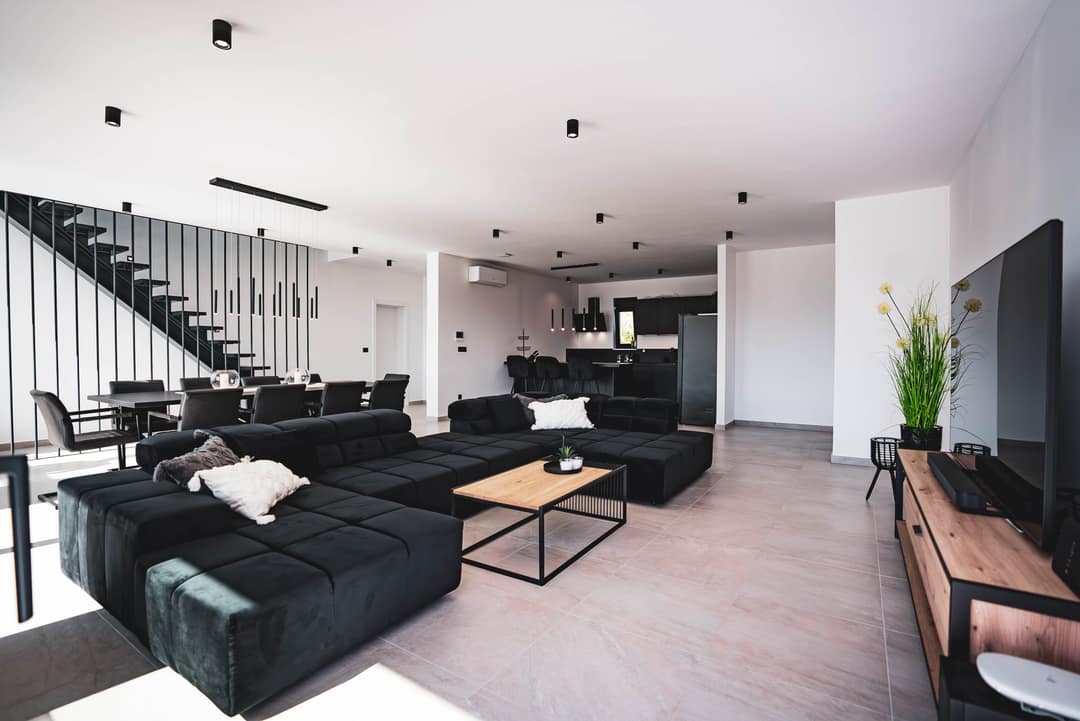
Equipment that really matters from four weeks
For a week of summer holiday, a pool and sea view are enough. For three months, other things count:
- Heating in every room, not just the living room. Dalmatian houses are designed for heat; without an air-conditioning split unit or radiators in the bedroom and workroom, January gets tough.
- Washing machine in the house - and ideally a covered place to dry, because when the jugo blows nothing dries outside.
- A proper workspace: table at writing height, office chair, sockets, daylight. A dining table with a bench becomes a back problem after the second week.
- Stable internet with usable upload and Wi-Fi coverage all the way into the workroom.
- A full kitchen: oven, enough cookware, freezer compartment, dishwasher. Cooking for yourself in winter is not an optional extra but everyday life.
- Dehumidification and ventilation: damp winter months by the sea are real - a dehumidifier is worth its weight in gold.
- A contact on site who responds within a day if the boiler or router fails.
If you'd like to browse our houses with this in mind, you'll find them in the overview of all villas .
Who it suits
A long stay in Kaštel Stari suits people who want to work in a focused way, see peace and quiet as a gain and not a lack, enjoy cooking for themselves and are willing to learn a few words of Croatian. It suits people less who need daily variety, nightlife or a large international environment.
If you're unsure which month and which house suit your plan: send us your planned dates, your work requirements and the number of people via the contact form . We'll tell you openly what is open in your chosen period, how the respective house is heated and what a month realistically costs.