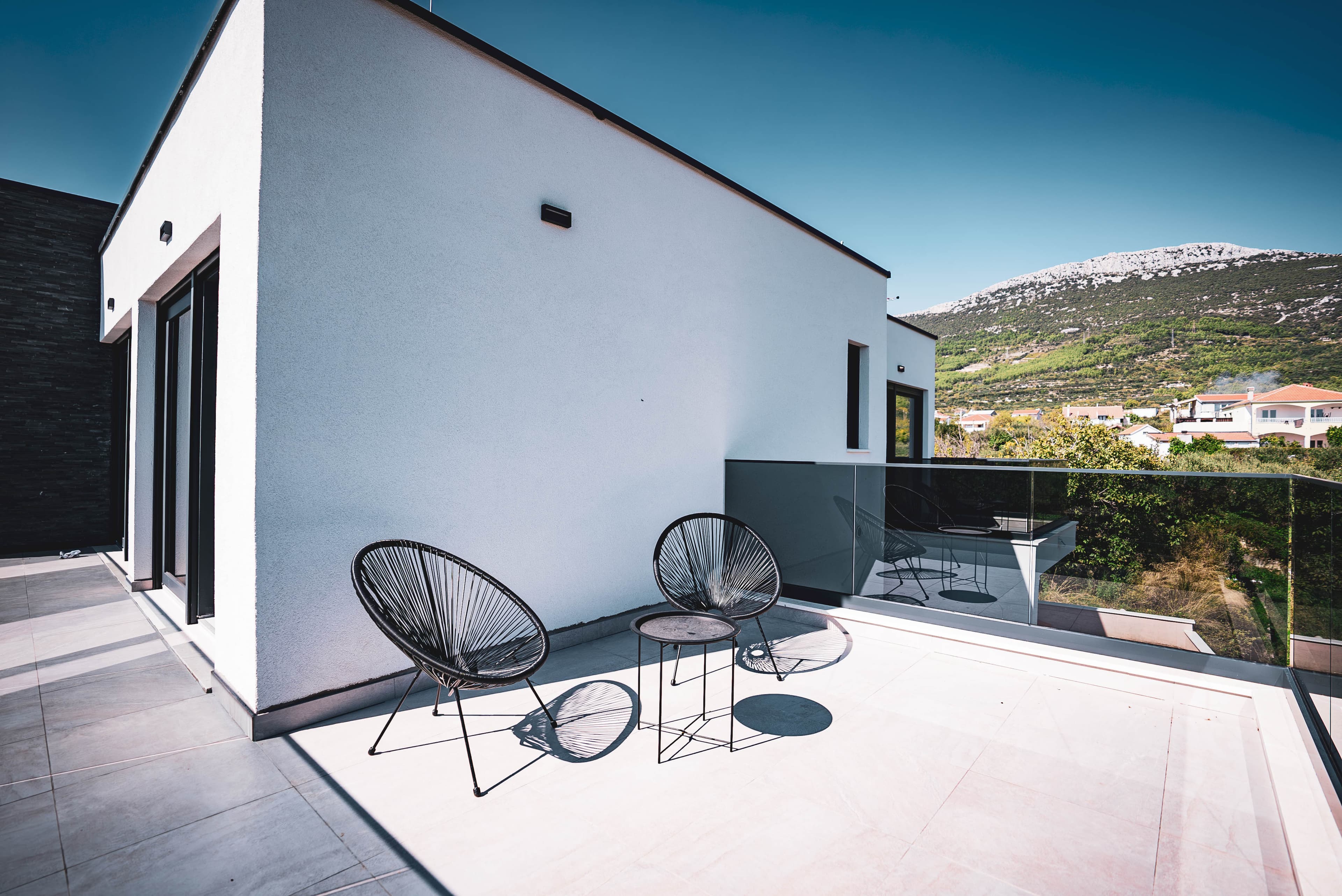
The most honest answer first: in April and October you can't swim in the sea in Dalmatia. At least not if you mean swimming in the pleasant sense of the word.
The Adriatic off Kaštela is around 15 to 16 degrees in April and about 20 degrees in October. That's the difference between a dare and lukewarm bathwater – but neither is what most people come to Croatia for.
And yet April, May, September and October are the better months for many of our guests. The reason is a heated pool, and the sums it changes are bigger than they first sound.
What a heated pool actually does
A pool kept at a pleasant temperature stretches the usable season from about three months to seven. That sounds like marketing, but it is simply physics: the pool doesn't care how warm the sea is.
In our houses the pool heating is included at no extra charge. You don't have to order it in advance, add it to your booking or call someone on the day of arrival. At Villa Just Be Alive, the pool and hot tub can also be controlled independently of each other.
This is a point on which price comparisons with booking platforms often turn. Where pool heating is billed separately, 30 to 60 euros per day is typical – in exactly the months when you need it. For a week in October that is up to 420 euros, which only appears in the small print of a supposedly cheaper offer.
Month by month, without rose-tinted glasses
April
Usually 18 to 20 degrees by day, cool at night. The sun already has strength, but the wind can still bite. At 15 degrees, the sea is not an option.
What works well: pool and hot tub, hiking on Mount Kozjak (practically impossible in high summer), Trogir and Split without the crowds, Krka National Park at pleasant temperatures. In March admission there costs only about 7 euros instead of 20 from April – if you are flexible, you save noticeably here.
What doesn't: beach days in the classic sense. Some beach bars are still closed. When it rains, April gets unpleasant because the terrace is out of action.
May
For us the most underrated month of the year. 23 to 25 degrees by day, the sea at around 18 degrees – possible for the hardy, while everyone else has the pool. Everything is open, but without the high-season rush. The landscape is green, which it no longer is in August.
September
The best compromise if you really want the sea. Around 26 degrees air temperature, 23 degrees water – the Adriatic is still warm after the summer. The biggest crowds have gone and prices fall.
October
21 degrees by day, water around 20 degrees. The month with the most beautiful light. Here the pool becomes the real argument, because the sea temperature is no longer enough for longer swims.
To be honest: towards the end of October the first seasonal restaurants and boat operators close. The bura, the cold katabatic wind from the interior, can make individual days unpleasant. In return, you have the beach practically to yourself.
November to March
A different category – but not a bad one. The seafront promenade is empty, there are mild sunny days in January, and prices are a fraction of August levels. In all rooms, air conditioning units that also heat keep you warm; in Villa Just Be Light and Villa Just Be Alive there is also underfloor heating in the bathrooms. If you are looking for a break rather than a beach holiday, this is exactly what you'll find. More on this in our article on long stays in Dalmatia .
The sums hardly anyone does
The price difference doesn't just affect the accommodation. In the off-season, almost everything gets cheaper:
- Villa: from around 250 euros per night instead of up to 1,000 euros in high season
- Flights: from around 120 euros return instead of 250 to 400 euros
- Hire car: from around 19 euros per day instead of 40 to 70 euros
- Krka admission: around 7 euros in March instead of 20 euros from April
- Restaurants: no waiting times, often more attentive service
For four people this quickly adds up to a four-figure difference – with the same villa, the same pool and the same view.
Who the off-season suits
- Couples without school-holiday constraints. The most obvious case.
- Remote workers. Stable Wi-Fi, a workspace with a view, into the pool in the afternoon. In August it would be too hot to work.
- Families with pre-school children. The heated pool replaces the beach completely – small children are less interested in the Adriatic than in splashing about right outside the door anyway.
- Hikers and cyclists. Mount Kozjak in July is an ordeal, in April a pleasure.
- Anyone with a dog. Heat is the biggest problem for dogs in Dalmatia in summer. See our article on holidays with a dog .
Who it's probably not for
If your picture of a holiday consists of long days in the sea, beach bars until late at night and the feeling that something is going on outside – then go in July or August. The pool replaces a lot, but not everything.
For a very short stay of three or four days, the off-season is also riskier: a spell of bad weather would cost proportionally more of your holiday.
What to pack for the off-season
- A warm layer for the evenings – it cools down noticeably after sunset
- Sturdy shoes if you want to walk on Mount Kozjak
- Something waterproof for April and October
- Swimwear, of course – the pool is waiting
In short
In April and October you trade sea temperature for peace and quiet, price and scenery. Whether that is a good trade depends on whether you have a heated pool. If you do, the answer is, in the vast majority of cases: yes.
Find our villas with a heated pool and hot tub here. Feel free to write to us with your preferred dates – we'll tell you honestly what to expect that week.